Introduction
When we think about working, we often imagine having a regular job. We work for a company, follow fixed working hours, and receive a salary at the end of each month. However, freelancing works a little differently.
To be honest, when I first tried to understand the difference between freelancing and a regular job, both seemed quite similar to me. In both cases, you use your skills to do work and earn money. The real difference is in how you work, who you work for, and how much freedom you have.
Let me share my own experience. In 2024, I was doing a 9 to 5 job at a marketing agency in Karachi. I had to leave home at 8 AM, sit in traffic for 1 hour, and my boss would check my screen every 30 minutes. My salary was fixed Rs. 60,000.
Then I quit and started freelancing on Fiverr. First 3 months were tough. Some months I earned Rs. 20,000, some months Rs. 80,000. But I was working from my bedroom in pajamas at 2 AM if I wanted to. That day I understood the real difference: Job = Security, Freelancing = Freedom.
Let’s understand this with a simple example. Imagine that Ali works for a company. He has to go to the office every day, his working hours are fixed, and he receives a salary every month. On the other hand, Ahmed is a freelancer. He can work from home or anywhere else, work on projects for different clients, and get paid according to each project.
Both of them are earning money by using their skills, but the way they work is different. That is why some people prefer regular jobs, while others find the flexibility and freedom of freelancing more attractive.
In this article, we will explain in simple words what the main differences are between freelancing and a regular job. We will look at their working hours, salary, freedom, and job security, and also discuss which option may be better for beginners.
How Is Freelancing Different From a Regular Job
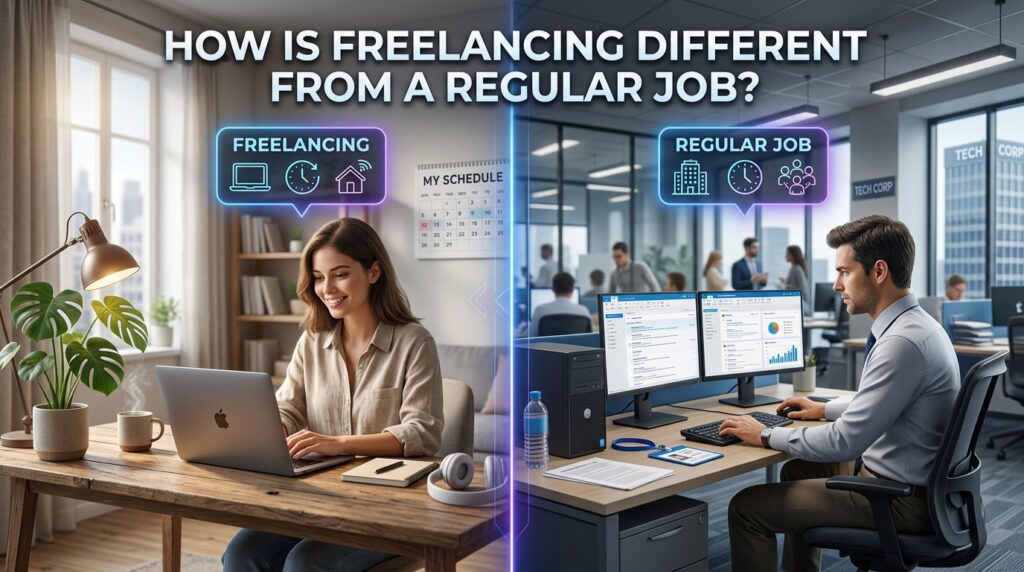
Both freelancing and regular jobs involve doing work and getting paid for it. However, the way you work in each is not the same. If you are a beginner, the easiest way to understand this difference is through a simple example.
Imagine that Ali has a regular job. He works for a company and has to follow the company’s rules. He usually has to work according to a fixed schedule. For example, if his working hours are from 9 a.m. to 5 p.m., he is expected to work during those hours.
Now, let’s look at Ahmed. Ahmed is a freelancer. He is not a permanent employee of one company. Instead, he works on projects for different clients. For example, one client may ask him to write an article for a website, while another client may give him a project to create content for social media.
The biggest difference here is that in a regular job, you usually work for one company, while in freelancing, you can work on projects for different clients.
The working style is also different. In a regular job, the company usually tells you what work you need to do and often when you need to do it. In freelancing, the client tells you about the project and its requirements, and you complete the work within the agreed deadline.
For a more detailed explanation of how independent contractors and employees can differ in areas such as schedule, location, rates, and work arrangements, you can read this [Upwork guide on independent contractors and employees][https://www.upwork.com/resources/independent-contractor-vs-employee].
You can also watch this English video for a simple comparison between freelancing and full-time employment [https://www.youtube.com/watch?v=o_hVh3z4kWQ].
You can also understand this through a school example. Imagine one student who goes to school every day and follows the timetable given by the teacher. This is similar to a regular job. Another student studies at home according to their own schedule and completes assignments for different subjects. This is a simple example of the flexibility that freelancing can offer.
However, this does not mean that a freelancer can work whenever they want without caring about deadlines. Freelancers also have to follow the client’s deadlines, instructions, and quality requirements. If a freelancer repeatedly delivers work late, the client may not want to work with them again.
In simple words, in a regular job, you work as part of a company’s system, while in freelancing, you work more flexibly with different clients and projects. Both require hard work and responsibility, but the way you work is different.
How Does Working as a Freelancer Compare With a Job

The easiest way to understand the difference between freelancing and a regular job is to look at what a freelancer and an employee do during a normal working day. Both of them work and earn money, but their daily routines can be quite different.
Imagine Ali works in an office. He gets ready in the morning, goes to the office, and completes the tasks given to him by his manager. Other members of his team are also working in the office. Sometimes there may be a meeting, sometimes his manager gives him a new task, and sometimes Ali may need to report on his work.
Now, let’s look at Ahmed. Ahmed is a freelancer. He often works from home using his laptop. He does not necessarily have one fixed office desk or a daily office routine. For example, if a client gives him a project to design a logo, Ahmed understands the client’s requirements, creates the logo, and delivers it within the agreed deadline.
This shows one simple difference: in a regular job, you are usually part of a company’s daily routine, while a freelancer manages their work according to their projects.
You can also understand this with a school example. Imagine a child who has a fixed school timetable. On Monday, they have Math, on Tuesday, Science, and on Wednesday, English. The child attends classes according to the school’s schedule. A regular job can work in a similar way, where you follow the company’s routine and working system.
Now imagine another child who studies at home. The child decides to study Math first and English afterward. They have more freedom to arrange their study time, but they still have to complete their homework. Freelancing can work in a similar way. A freelancer may have more freedom to manage their time, but completing the client’s work before the deadline is still their responsibility.
For a broader explanation of how freelance work differs from traditional employment, you can also read [Upwork’s guide to freelancing] [https://www.upwork.com/resources/what-is-freelancing].
Another important difference is that a regular employee often has a manager or supervisor who provides guidance. If Ali faces a problem, he can usually ask his manager for help. A freelancer, however, often has to solve problems independently. If a client asks for changes to a design, the freelancer needs to understand those changes and complete the work themselves.
A freelancer also has responsibilities beyond their main skill. They may need to communicate with clients, understand project details, remember deadlines, and keep track of payments. In other words, freelancers often have to manage several parts of their work themselves.
However, there is a positive side to this as well. If Ahmed finishes his work early and does not have another urgent project, he may be able to use the remaining time for something else. A regular employee, on the other hand, will usually still have to follow the company’s working schedule.
This is why it is not completely accurate to think of freelancing as simply working from home Freelancing can provide more freedom, but that freedom also comes with responsibility. You have to manage your own time, communicate with clients, and make sure your work is completed on time.
If you want to learn more about managing your time and staying productive while working independently, you can also explore [Harvard Business Review’s advice on managing your time][https://hbr.org/2020/01/how-to-manage-your-time].
Do Freelancers Have Fixed Working Hours
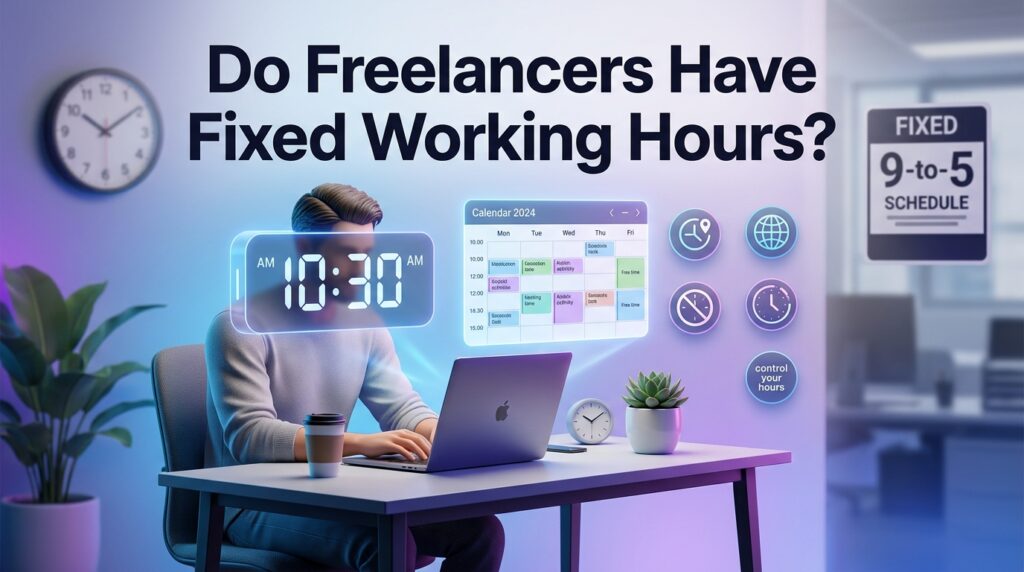
If you are thinking about starting freelancing, you may have this question in your mind: “Do freelancers also have to work from 9 a.m. to 5 p.m. every day?” The simple answer is: usually, no. Freelancers generally do not have to follow fixed working hours like regular office employees. They often have more flexibility in managing their work, but they still need to meet client deadlines and follow project requirements.
Let’s understand this with a simple example. Imagine Ali works in an office. His company’s working hours are from 9 a.m. to 5 p.m. Ali usually has to stay at the office and complete his work according to this schedule.
Now consider Ahmed, who is a freelancer. A client has given him a project to write two blog articles and asked him to complete the work by Friday. Ahmed does not necessarily have to start working at 9 a.m. He can work at 10 a.m., take a break in the afternoon, and if he finds it more convenient to work at night, he can complete some of the work in the evening.
This means that for a freelancer, the important thing is usually to complete the work within the agreed deadline and maintain good quality, rather than working at the same fixed time every day. According to Indeed, freelancers may have considerable flexibility in choosing their working hours for project-based work, as long as they meet their deadlines [https://www.indeed.com/career-advice/finding-a-job/flexible-working-hours].
You can understand this even more easily with a school example. Imagine your teacher tells you that your homework must be submitted on Friday. You can do the homework on Monday, Tuesday, or Wednesday depending on how you plan your time. However, you still have to complete it by Friday.
Freelancing can work in a similar way. The client gives you a project and a deadline, while you can often decide when to work on it according to your available time.
However, this does not mean that freelancers can simply work whenever they want without needing any schedule. If you have multiple clients, you need to manage your time properly. For example, if three clients give you different projects, you have to decide which project should be completed first and when each deadline is due.
In some freelance projects, specific working hours may also be important. For example, if you are providing regular communication or live support for a client, the client may expect you to be available during certain hours. Similarly, in hourly freelance contracts, a client may set a weekly limit on the number of hours you can work. According to [Upwork’s official help information] weekly hour limits can be included as part of an hourly contract agreement [https://www.upwork.com/help].
In simple words, freelancers usually do not have to work at the same fixed time every day like regular office employees. They can often manage their schedules with greater flexibility, but they cannot ignore deadlines, quality standards, or client requirements.
Do Freelancers Have a Fixed Monthly Salary

If you work a regular job, you usually receive a fixed salary every month. For example, if Ali earns $500 per month, he can expect to receive $500 at the end of the month, as long as there is no change in his job or salary.
Freelancing is a little different. A freelancer usually does not receive a fixed monthly salary from one company. Their income depends on how many projects they receive, how much they charge for their services, and how much work they complete.
Let’s understand this with a simple example. Ahmed is a freelancer who designs logos. In January, he gets five clients and charges each client $100. His total income could be $500. However, if he gets only two clients in February, his income could be $200.
This means that a freelancer’s monthly income does not necessarily remain the same every month.
Freelancers can receive payments in different ways. In some projects, the client agrees to pay a fixed amount for the entire project, while in other contracts, the freelancer is paid according to an hourly rate. For example, Upwork offers both hourly and fixed-price contracts. You can learn more about these two payment models in [Upwork’s official guide] [https://www.upwork.com/resources/hourly-vs-fixed-price].
If a freelancer completes a fixed-price project worth $150, they may receive the agreed amount after completing the project. If they work on an hourly basis, their earnings are calculated according to their agreed hourly rate and the number of hours worked. According to [Upwork’s official payment guide] hourly contracts are paid based on the hours worked, while fixed-price contracts are paid according to the project or agreed milestones [https://www.upwork.com/resources/payment-protection].
You can also understand this with a school example. Imagine one student receives a fixed amount of pocket money from their parents every month. They already know how much money they will receive. Now imagine another student who earns money by making drawings for others or helping with school projects. Their income depends on how many people ask them to do this work. A freelancer’s income works in a similar way.
Therefore, it would not be correct to think of freelancing as a regular job with a fixed salary. A freelancer’s income can be lower in some months and higher in others. At the same time, freelancers have to manage their projects, clients, rates, and workload themselves.
Who Chooses the Work in Freelancing
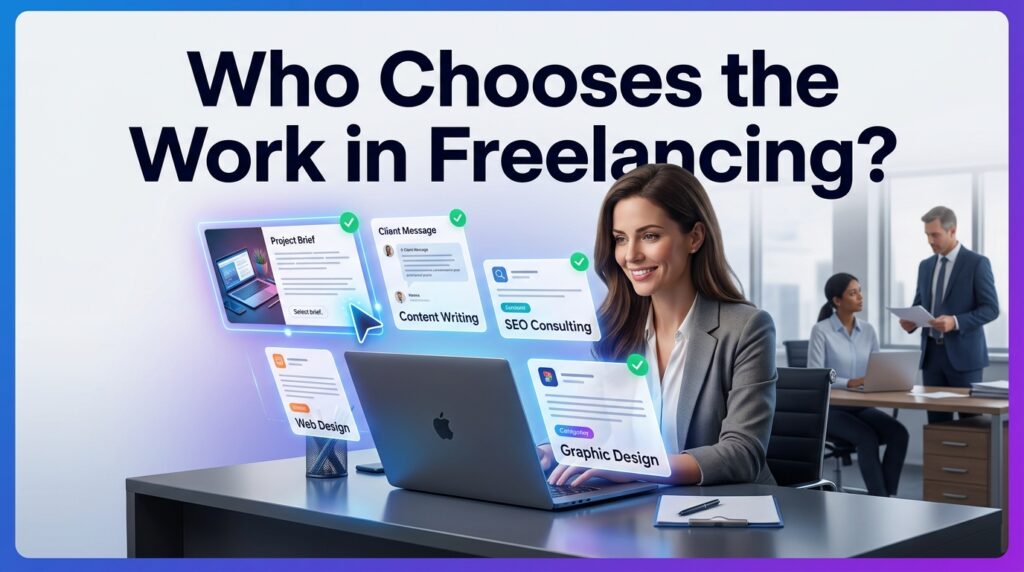
Choosing work in freelancing is a little different from working a regular job. If you have a regular job, the company or manager usually decides what work you need to do. In freelancing, however, freelancers have more freedom to choose which types of projects they want to work on.
Let’s understand this with a simple example. Imagine Ali works as a graphic designer in a company. His manager tells him that he needs to design a company brochure today. Ali has to complete the task whether he is interested in that project or not.
Now, let’s look at Ahmed. Ahmed is also a graphic designer, but he works as a freelancer. He receives projects from two different clients. The first client wants him to design a logo, while the second client wants social media posts designed. Ahmed can look at the details of both projects and decide which project he wants to accept.
This is an important thing to understand: a freelancer does not have to automatically accept every project. If a project does not match their skills, the payment is not suitable, or the deadline is too difficult, they can choose to reject the project.
Freelancing platforms also allow freelancers to search for projects and apply for work. For example, on Upwork [https://www.upwork.com], freelancers can browse available projects and submit proposals for projects that match their skills. You can learn more about finding freelance work in Upwork’s official guide [https://www.upwork.com/resources/how-to-find-freelance-work].
In simple words, in a regular job, the company or manager usually tells you what work you need to do, while freelancing gives you more freedom to choose which projects you want to accept. However, this freedom also comes with responsibility. Freelancers need to find projects, evaluate them, and decide which work is right for them.
What Are the Disadvantages of a Regular Job
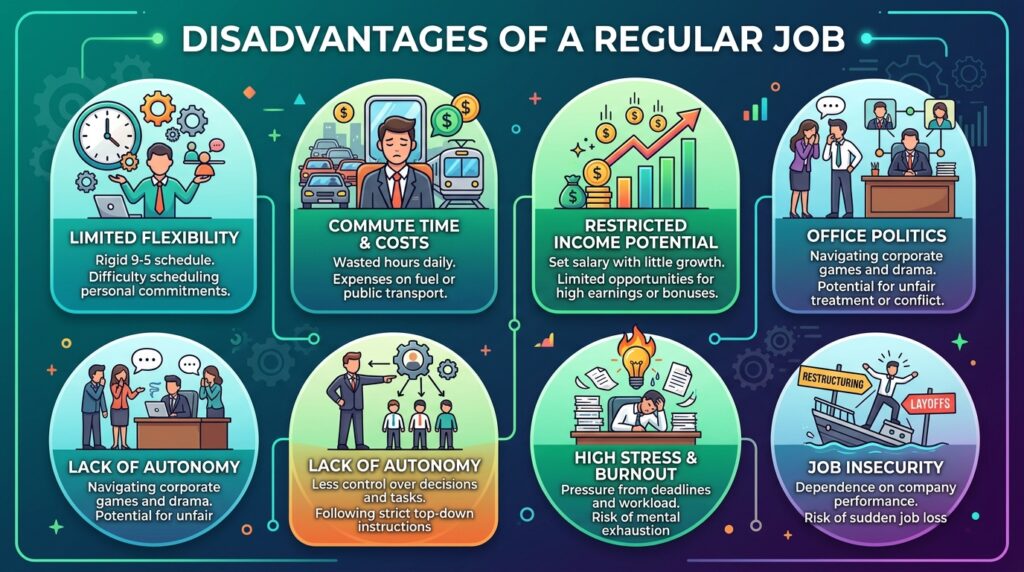
A regular job has many benefits, such as a stable salary, a fixed routine, and a structured working environment. However, like anything else, it also has some disadvantages.
Main Disadvantages:
- 1. Fixed Working Hours – You cannot decide to come at 11 AM even if you finish work early
- 2. Commuting Time – 2 hours daily in traffic like I used to in Karachi
- 3. Less Control Over Tasks – Your manager decides what you will do today
- 4. Limited Income Growth – To increase salary from $500 to $1000, you need promotion, not just hard work
- 5. Location Bound – You have to be present in office. You cannot work from another city easily
The [U.S. Bureau of Labor Statistics provides information about how workers spend their time during the workday [https://www.bls.gov].
In simple words, some common disadvantages of a regular job can include fixed working hours, less flexibility, assigned tasks, commuting, workplace pressure, limited control over income, and less freedom to choose where and how you work. The right choice depends on your personality, lifestyle, financial needs, and career goals.
Which Is Better for Beginners: Freelancing or a Job
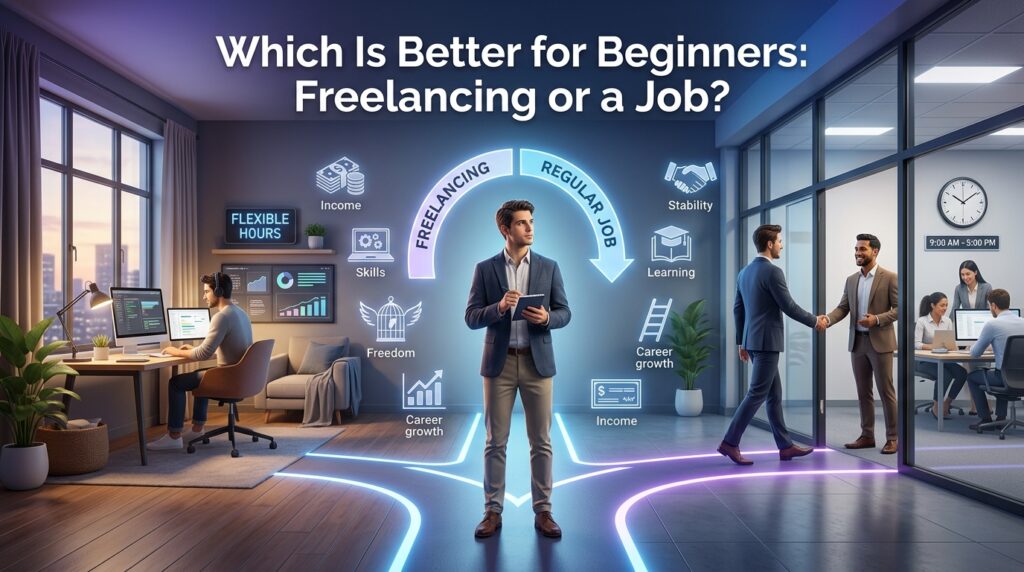
If you are just starting your working life, you may have an important question in your mind: Is freelancing better, or should I get a regular job? Both options can be good, but the better choice depends on your situation.
Let’s understand this with a simple example. Imagine Ali has recently completed his studies and wants to start earning money. He does not have a strong freelancing skill yet, and he wants to receive a fixed income every month. In this situation, a regular job may be a more suitable starting point for him.
Now let’s look at Ahmed. Ahmed is good at graphic design. He has a laptop, prefers working from home, and wants to work on projects for different clients. For Ahmed, freelancing could be an interesting option because he can use his skill directly to provide services to clients.
For more information about how freelancing works and why people choose it, you can also read [Indeed’s guide to freelancing [https://www.indeed.com/career-advice/finding-a-job/what-is-freelancing].
One attractive benefit of freelancing is flexibility. A regular job does not always offer this level of flexibility. If a company has working hours from 9 a.m. to 5 p.m., an employee will generally need to follow that schedule.
Learning is also very important for beginners. If you do not have a freelancing skill yet, it may be better to learn a useful skill before trying to find clients. For example, you could learn content writing, graphic design, video editing, digital marketing, virtual assistance, or another skill that people are willing to pay for.
If you want to understand the practical difference between freelancing and full-time employment, you can also watch this detailed YouTube explanation [https://www.youtube.com/watch?v=9BdbGZtnFnQ].
Some beginners choose to do both. For example, someone may have a regular job while learning freelancing in their free time. They may start with small freelance projects and gradually build their skills, portfolio, and client base. Once their freelancing becomes stronger, they can decide whether they want to make it a full-time career.
In simple words, if you want a fixed income, a structured routine, and workplace experience, a regular job can be a good choice for a beginner. If you already have a useful skill, prefer flexibility, and want to work independently with clients, freelancing may be a better option for you.
Related Articles
- Can You Freelance Part Time While Studying or Working
- How Can Freelancers Build a Long Term Career Online
Frequently Asked Questions
- Q1: Can I do freelancing along with my regular job?*
- Ans: Yes. Many people start freelancing part-time. Just make sure you are not breaking any contract with your company and you can manage both deadlines.
- Q2: Which one is more secure, freelancing or a job?*
- Ans: A regular job is more secure for fixed monthly income. Freelancing is less secure but has higher earning potential if you are consistent.
- Q3: Do I need a degree to start freelancing?*
- Ans: No. Clients care about your portfolio and skills, not your degree. I started with just Canva skills and no degree.
- Q4: How long does it take to earn stable income from freelancing?*
- Ans: It usually takes 3 to 6 months. First 2 months are the hardest. After you get 5-10 good reviews, clients start coming to you.
Conclusion
Freelancing and regular jobs are both good options, but the better choice for a beginner depends on their situation. If you want a fixed income, a structured routine, and workplace experience, starting with a regular job can be a practical decision.
If you have a useful skill, enjoy working independently, and want more control over your time, freelancing may be a better option for you. However, freelancing also requires patience, responsibility, and consistent effort.
Based on my experience, the best approach for many beginners is to start with a regular job to learn discipline, and then start freelancing on the side. Gradually improve your skills, gain experience, and see which path gives you more confidence and opportunities for growth.
In simple words, there is no single option that is best for everyone. Your goals, skills, financial needs, and lifestyle will help you decide whether freelancing or a regular job is better for you. The most important thing is to keep learning and improving, no matter which path you choose