Introduction
Before understanding this topic, it is important to know one simple thing. When people start freelancing, they often believe that they need clients before they can build a portfolio. And because they do not have any clients yet, they wonder how they can create a portfolio in the first place. This is a common concern for many beginners.
Let me share my real story. When I started freelancing, I had zero clients. I applied to 30 jobs on Upwork and got rejected every time. The reason? “No portfolio”. So I stopped applying for 2 weeks. Instead, I created 4 fake projects: A logo for a fake coffee shop, 3 Instagram posts for a fake clothing brand, 1 blog article, and 1 YouTube thumbnail. I uploaded them to my Fiverr profile. In the next 10 days I got 2 orders. That’s when I learned: Clients don’t buy “experience”. They buy “proof”.
Imagine a student who has just learned how to drive. They have practiced in a driving school, but they have never driven professionally for a company. Does that mean they do not know how to drive? Of course not. They have already learned the skill through practice and training. Building a freelance portfolio works in a very similar way.
Even if you do not have any clients yet, you can still create work samples that showcase your skills. A content writer can write sample articles, a graphic designer can create practice designs, and a video editor can produce demo videos. In many cases, clients want to see the quality of your work more than the number of clients you have worked with.
In this article, we will use simple examples to explain how you can build a portfolio without clients, what types of work samples you should create, and how beginners can professionally showcase their skills.
How Can You Build a Freelance Portfolio Without Any Clients
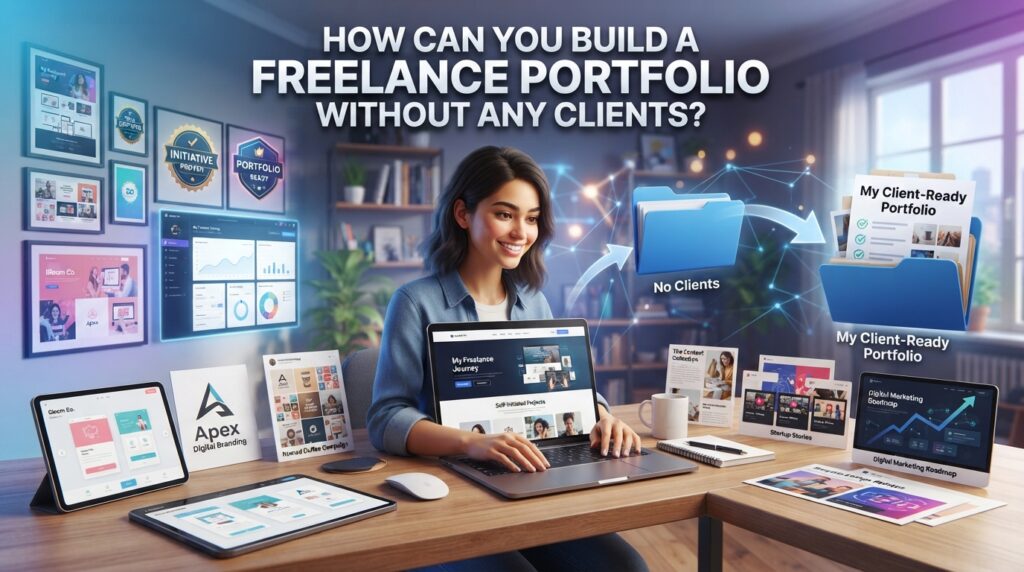
Many beginners think that building a portfolio is impossible without clients. They often ask, “If I don’t have any clients, what can I put in my portfolio?” This is a very common concern because most people assume that a portfolio can only contain paid work. However, that is not true. A portfolio is simply a collection of work that demonstrates your skills.
Let’s understand this with a simple example. Imagine a child who wants to participate in a school drawing competition. Before entering the competition, the child spends time practicing at home by drawing houses, trees, animals, and different objects. Even though nobody paid the child to create those drawings, they still prove that the child knows how to draw. A freelance portfolio works in exactly the same way.
3 Types of Sample Projects You Can Make Today:
- 1. Redesign Projects – Pick a real brand with bad design and redesign it. Ex: “Redesign of McDonald’s Instagram Post”
- 2. Fake Brand Projects – Create a fictional brand “Urban Wear” and make logo + 5 posts + business card for it
- 3. Problem-Solving Projects- Find a problem on YouTube/TikTok and make a solution. Ex: “YouTube Thumbnail for Tech Video”
For example, if you want to become a content writer, you can write sample blog posts on topics that interest you. If you want to become a graphic designer, you can create logos, social media posts, banners, or business cards for imaginary companies. If you want to become a video editor, you can edit practice videos and use them as portfolio samples.
Think about it this way. Imagine two beginner freelancers apply for the same project. The first freelancer says, “I have no clients.” The second freelancer says, “I have no clients yet, but here are five examples of my work.” Most clients will naturally feel more comfortable with the second freelancer because they can actually see what that person can do.
You can even build portfolio projects around real businesses. For example, you could redesign a local restaurant’s menu, create social media graphics for an imaginary clothing brand, or write a sample article for a technology website.
If you would like to learn more about creating a beginner portfolio, the official guide from [Upwork Career Resources](https://www.upwork.com/resources/how-to-create-a-freelancer-portfolio) provides practical advice [LINK 1]. You can also watch this detailed YouTube guide: [How to Build a Portfolio With No Experience](https://www.youtube.com/watch?v=Q-omi1Cigy0) [LINK 2].
Another important point is to focus on quality rather than quantity. Three excellent samples are often more valuable than ten average ones. Instead of rushing to create many projects, spend time creating a few strong examples that clearly demonstrate your skills and attention to detail.
In simple words, you do not need clients to build a portfolio. You need skills, practice, and examples of your work.
Can You Build a Portfolio Before Getting Your First Client
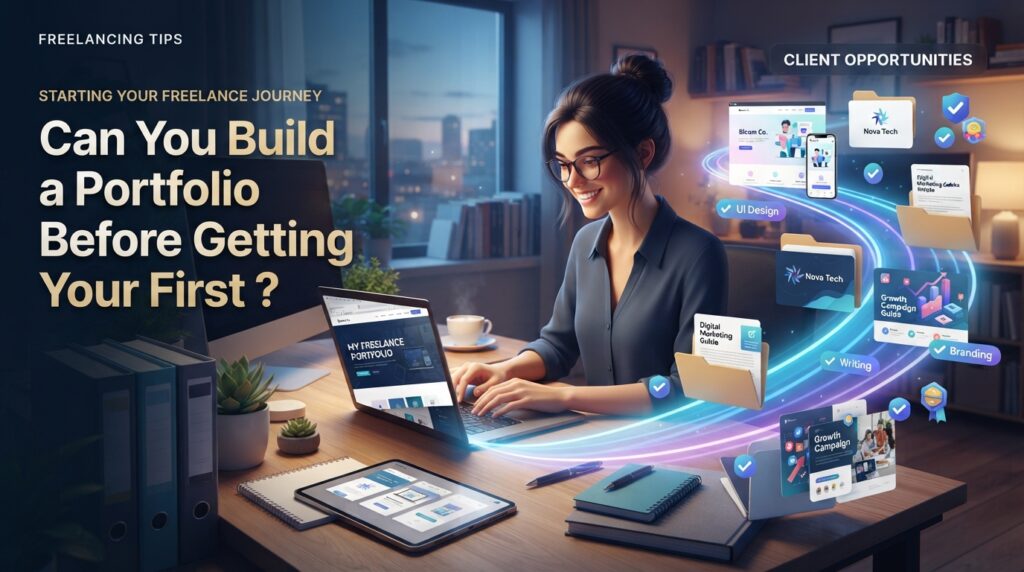
Many beginners believe that they need a client before they can build a portfolio. Because of this, they often get stuck and think, How can I create a portfolio if nobody has hired me yet. This is a very common misunderstanding, but the truth is much simpler.
Let’s understand it with a simple example. Imagine a child who wants to join a football team. Before the coach selects players, the child spends time practicing football at home and on the playground. The child learns how to pass, shoot, and control the ball. Even though the child has never played an official match, they are still improving their skills and preparing themselves. A freelance portfolio works in a similar way.
A portfolio is simply a collection of work that shows what you can do. It is not a collection of clients. Clients use portfolios to see your skills and the quality of your work. Because of this, you can start building a portfolio long before you get your first paying client.
My 3-Step Formula to Build Portfolio in 7 Days:
- 1. Day 1-2: Pick 1 Niche. Ex: Instagram Posts for Restaurants
- 2. Day 3-5: Create 3-4 sample projects for that niche
- 3. Day 6-7: Upload them to Behance, Google Drive, and Fiverr profile
Many beginners make the mistake of waiting for their first client before creating any samples. This can slow down their progress because clients often want to see proof of skills before hiring someone. Creating your own projects helps solve this problem and gives you something valuable to showcase.
You can even create portfolio projects based on real-world situations. For example, you could redesign a restaurant menu, create social media graphics for an imaginary clothing store, write sample articles for a technology blog, or edit a practice YouTube video.
If you would like to learn more about creating a portfolio as a beginner, the official guide from Upwork Career Resources explains how freelancers can showcase their skills professionally [https://www.upwork.com/resources/how-to-create-a-freelancer-portfolio]. You can also watch this detailed video guide [https://www.youtube.com/watch?v=Q-omi1Cigy0].
In simple words, yes, you can absolutely build a portfolio before getting your first client. In fact, many successful freelancers create their portfolios before they ever earn their first dollar online.
Do You Need Clients to Build a Freelance Portfolio
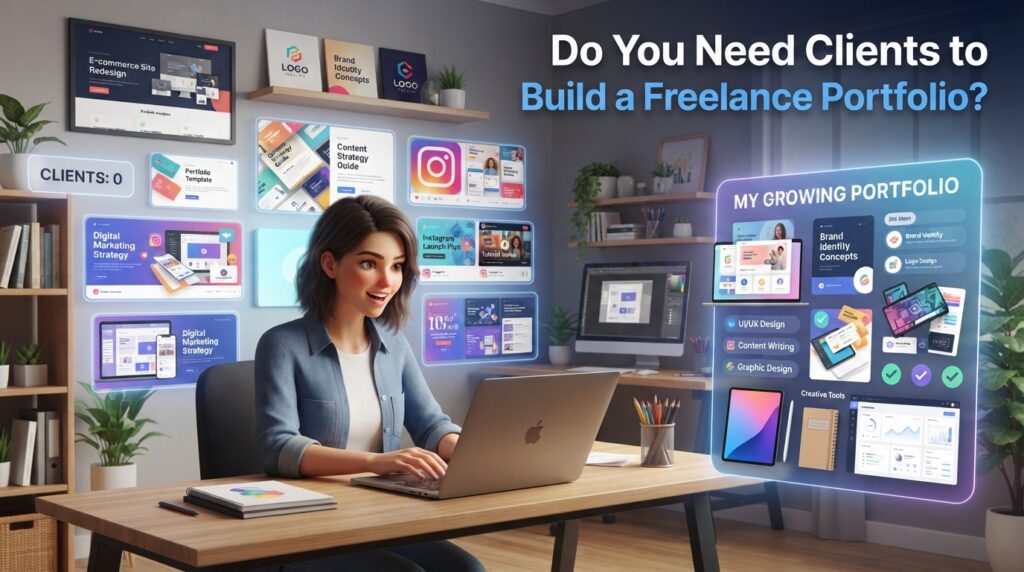
Many beginners believe that clients come first and the portfolio comes later. Because of this, they often think, “I don’t have any clients yet, so I can’t build a portfolio.” This idea sounds reasonable at first, but in reality, it is one of the biggest misunderstandings new freelancers have.
Let’s understand this with a simple example. Imagine a child who wants to join a school art competition. Before the competition begins, the child spends time drawing pictures at home and practicing different techniques. The child does not wait for a teacher to pay them for a drawing before practicing. Instead, they create artwork first and then show it to others. A freelance portfolio works in a very similar way.
A portfolio is simply a collection of work that shows your skills. It is not a collection of paying clients. Clients look at your portfolio because they want to know whether you can do the work they need. They are usually more interested in the quality of your work than in whether someone paid you to create it.
Where to Host Your Portfolio for Free in 2026:*
- 1. Writers – Google Docs + Publish on Medium
- 2. Designers – Behance + Canva Portfolio
- 3. Video Editors – YouTube Unlisted Videos + Google Drive
- 4. All Skills – Adobe Portfolio[https://www.adobe.com/products/portfolio.html]
Think about two beginners applying for the same project. The first person says, “I have no clients, so I don’t have a portfolio.” The second person says, “I haven’t worked with clients yet, but here are examples of my work.” Most clients will feel more confident choosing the second person because they can actually see the quality of the work.
Many successful freelancers started exactly this way. Before getting paid projects, they created practice work, personal projects, and sample pieces to demonstrate their skills. These samples later helped them attract their first clients because clients had something concrete to evaluate.
If you would like to learn more about creating a strong portfolio as a beginner, the guide from [Adobe Portfolio Blog](https://blog.adobe.com/en/publish/2021/09/14/how-to-create-a-portfolio-with-no-experience) provides useful tips and examples [https://blog.adobe.com/en/publish/2021/09/14/how-to-create-a-portfolio-with-no-experience].
In simple words, no, you do not need clients to build a freelance portfolio. A portfolio is meant to show your skills, and you can create work samples on your own.
Related Articles
- How Can You Start Freelancing Without Experience
- How Can Beginners Improve Their Freelancing Skills Over Time
Frequently Asked Questions
- Q1: How many samples should I put in my portfolio as a beginner?*
- Ans: 3 to 5 high-quality samples are enough. 1 logo is better than 10 bad logos. Focus on quality and relevance to the service you are selling.
- Q2: Is it okay to say my samples are “practice projects”?*
- Ans: Yes, 100% okay. Be honest. Write: “Concept Project for XYZ Brand”. Never lie that a real client paid you. Clients respect honesty.
- Q3: Which is better: PDF portfolio or Website portfolio?*
- Ans: For beginners, start with Google Drive folder + Behance. It’s free and professional. When you earn $500+, then build a simple website.
- Q4: My samples look bad compared to pro freelancers. Should I still post them?*
- Ans: Yes. Your portfolio will improve with time. Version 1 will always be bad. My first Canva design was terrible. But without posting it, I would never have gotten client feedback to improve.
Conclusion
Building a freelance portfolio without clients may seem difficult at first, but it is actually one of the most practical ways to prepare for your freelancing journey. Every experienced freelancer started somewhere, and most of them did not have paying clients when they created their first portfolio samples.
The important thing to remember is that clients are not only looking for experience—they are looking for proof that you can do the work. This proof can come from practice projects, personal work, sample articles, designs, videos, or any other examples that demonstrate your skills. A strong portfolio helps clients understand what you can do and gives them confidence in your abilities.
Based on my experience, don’t wait for “perfect”. Launch with 3 samples today. Improve them after every client. Your portfolio is a living document.
If you are a beginner, do not wait for the perfect opportunity before taking action. Start creating work samples, improve your skills through practice, and continue adding better projects to your portfolio over time. Every sample you create is a step toward building credibility and attracting future clients.
In simple words, a portfolio is not something you build after becoming successful—it is one of the tools that helps you become successful. Focus on showing your skills, keep learning, and keep improving. Your first client may take some time to arrive, but a well-prepared portfolio can make that journey much easier and increase your chances of getting noticed.